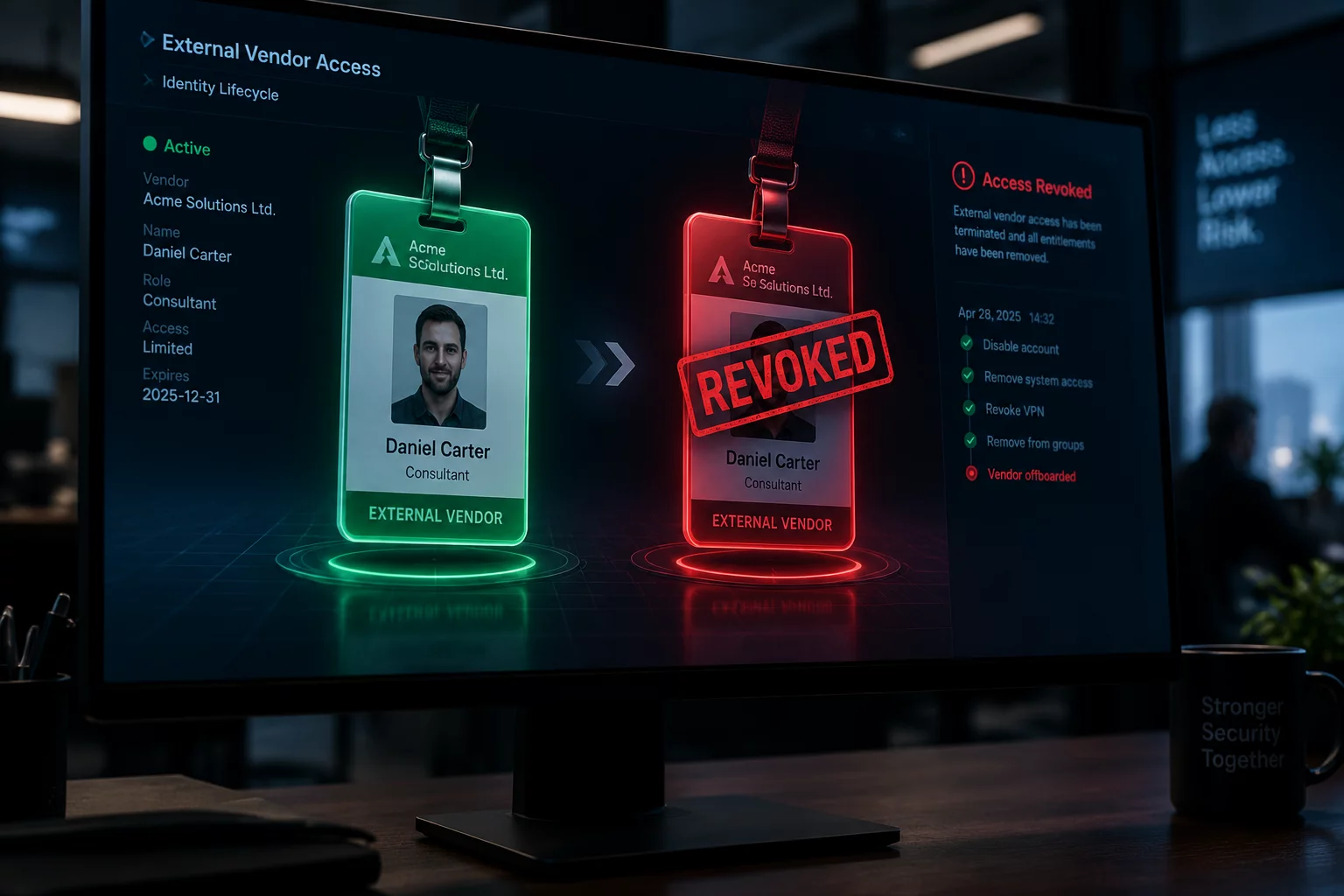
Third-Party Data Custody and Offboarding Risks
Contracting third-party firms or specialized contractors inevitably introduces fragmented access points across company file servers and storage repositories. When engagements terminate, these collaborative folders frequently become unmonitored zones with lingering permissions.
Without a rigorous transfer protocol, external contractor directories become security vulnerabilities and storage bloat. Enterprise file servers collect gigabytes of preliminary drafts, confidential customer deliverables, and uncurated source code that internal teams rarely inspect after project completion. Offboarding requires systematic ownership re-allocation, preventing dormant shares from persisting indefinitely across corporate storage networks.
Mandatory ACL Revocation Window
Contractual service agreements must specify immediate ACL revocation on the final service date. All directory permissions assigned to external vendor security groups must be stripped within 24 hours of project conclusion, accompanied by an audit record signed by the internal sponsor.
Three-Stage Vendor Data Custody Transition
To guarantee business continuity without compromising data security, the offboarding lifecycle follows a structured sequence dividing discovery, ownership reassignment, and formal decommissioning into manageable stages.
Phase 1: Active Directory & Storage Tree Walk
The project coordinator and systems administrator execute a comprehensive discovery scan across shared volumes to trace every directory created or modified under vendor credentials.
- Execute TreeSize automated reporting to index all vendor-attributed file hierarchies and quantify total allocated storage.
- Identify duplicate deliverables, transient staging folders, and external script repositories.
- Compile a complete inventory list containing folder paths, last access timestamps, and storage quotas.
Phase 2: Successor Owner Verification
Custodianship of permanent project deliverables transfers directly to a designated internal department manager or operational team lead.
- Assign explicit primary ownership to the internal business sponsor in Active Directory attributes.
- Strip external contractor accounts from Access Control Lists (ACLs) and transition inherited access.
- Verify read/write integrity with internal stakeholders who require ongoing access to historical documentation.
Phase 3: Ledger Update & Archival Confirmation
Archival verification and formal sign-off ensure that unneeded workspace caches are cleaned up while compliance archives are sealed.
- Move inactive project archives to immutable secondary storage or long-term compliant vaults.
- Record cryptographic hash logs in the central stewardship ledger to preserve chain-of-custody proof.
- Issue the final directory handover certificate to procurement and IT risk governance officers.
Governance Verification and Access Policies
Ensuring thorough compliance during vendor transitions requires auditing both logical security boundaries and long-term retention requirements. These operational checkpoints clarify common edge cases.
Schedule Ownership Transfer Protocol
Submit this form to initiate an IT directory audit ledger transfer for this specific scenario. Our governance team verifies custodian identity and generates audit logs.