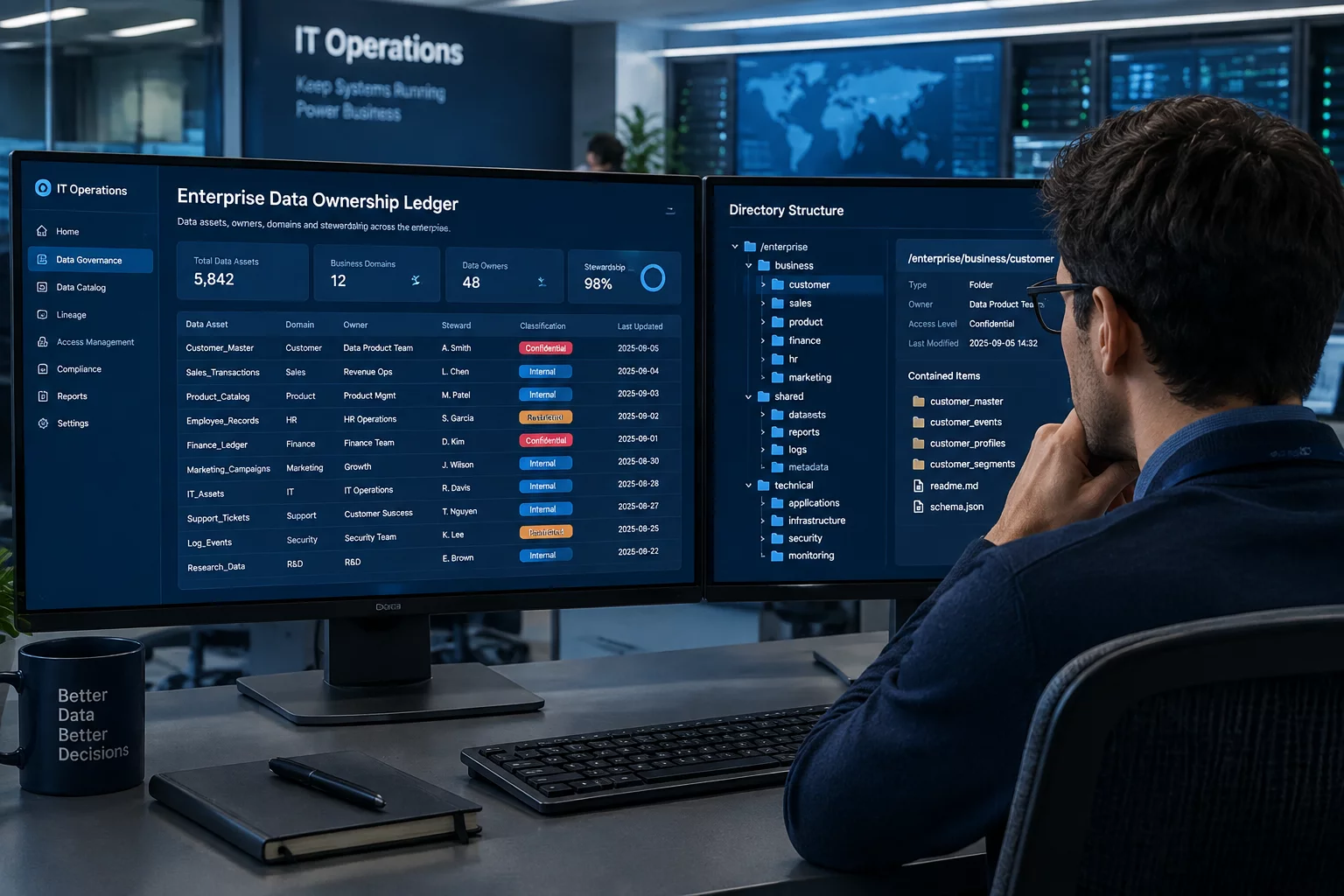
About the FolderSteward Handbook Initiative
The FolderSteward Handbook was engineered to solve an ubiquitous enterprise challenge: massive volume sprawl and orphaned network shares where gigabytes and terabytes of data accumulate without designated custodians, defined retention criteria, or operational handoff protocols.
Our Purpose & Mission
Traditional storage administration focuses heavily on raw metrics—drive capacity, sector health, and provisioning quotas. However, raw metrics fail when systems administrators ask fundamental questions: Why was this directory created? Who approves archival? Which business team owns this workspace?
The FolderSteward Handbook establishes a standardized operating methodology that bridges IT operations, compliance teams, and business units to maintain permanent metadata clarity, continuous folder stewardship, and disciplined storage lifecycles.
The Operational Gap We Address
When organizational reorganizations occur or project leads transition, root-level folder ownership typically disintegrates into "ghost directories." IT staff hesitate to delete obsolete data due to liability risks, while business teams assume IT is managing record retention.
Technical storage capacity is an organizational responsibility, not merely an infrastructure budget line. Without recorded intent and explicit custodians, storage perpetually degrades.
Handbook Governance Framework
Explore the four foundational pillars embedded across our operational protocols.
Deterministic Single-Point Stewardship
Every shared directory, archive namespace, and department storage volume must map to a primary verified human owner and a designated secondary contact. Shared group accounts or abstract labels like "Marketing" do not satisfy governance requirements.
- Annual ownership validation checkpoints
- Direct accountability for access grant reviews
- Immediate trigger workflows upon employee offboarding
{
  "folder_path": "/shares/product-eng",
  "primary_steward": "alex.chen@org.local",
  "secondary_steward": "ops-lead@org.local",
  "last_verified": "2026-08-15",
  "retention_policy": "7_YEAR_STATUTORY"
}
Documenting Contextual Purpose
Folders without explicit purpose declarations become black boxes that cannot be pruned safely. Our documentation templates enforce root-level intent summaries (`README.md` or manifest records) specifying dataset lifetime, regulatory scope, and disposal timelines.
- Defined classifications for active versus cold data
- Statutory retention compliance indicators
- Deprecation schedules for project-specific scratch spaces
[DIRECTORY_MANIFEST]
Purpose: Q3 Audit Artifacts
Created_By: Financial Governance
Disposal_Action: Cold Deep Glacier Archive
Expiry_Trigger: 2027-12-31
PII_Contained: FALSE
Analysis & Tool-Neutral Discovery
Effective stewardship leverages disk analysis utilities—such as TreeSize, CLI crawlers, and storage reporting scripts—to detect volume bloat, duplicate tree hierarchies, and unreferenced legacy repositories before they impact operational cost.
- Automated tree visual scans and depth profiling
- Identification of stale extensions (.bak, .tmp, .iso)
- Continuous threshold monitoring for share quotas
SCAN_RESULT: /srv/data/legacy-export
TOTAL_ALLOCATED: 4.82 TB
LAST_ACCESS_DELTA: 842 DAYS
STALE_OBJECTS_PCT: 94.2%
RECOMMENDED_ACTION: FLAG_STEWARD_AUDIT
Structured Handoff & Archival Lifecycles
Data transitions must be as rigorously executed as employee handoffs. The handbook provides deterministic checklists for reallocating directory responsibility during organizational shifts, system migrations, or contract completions.
- Signed custodian transfer protocols
- Read-only grace periods prior to permanent deletion
- Immutable snapshot logging of handoff agreements
HANDOFF_STAGE: GRACE_PERIOD_30_DAYS
ORIGIN_STEWARD: mark.davies (Departed)
TARGET_STEWARD: data-ops-governance
ACL_MODIFICATION: READ_ONLY_ENFORCED
PURGE_LOCK: ACTIVE
Core Curated Knowledge Tracks
Architectural best practices for capacity planning, quota enforcement, and tier-based storage segmentation.
Explore ModuleFrameworks for designating custodian roles, access authorization matrixes, and annual validation audits.
Explore ModuleStandard operating procedures for authoring directory manifests, compliance tags, and intent registries.
Explore ModuleTechnical guides on utilizing TreeSize diagnostics to map allocation anomalies, stale trees, and bloat.
Explore ModuleScenario-based execution runbooks for staff reorganizations, project retirements, and offboarding events.
Explore ModuleNeed support integrating stewardship policies into your IT workflows? Reach out to our maintainers.
Contact MaintainersWho This Handbook Is For
The FolderSteward Handbook is written for practitioners who manage shared storage, oversee departmental data, and coordinate ownership transitions.